

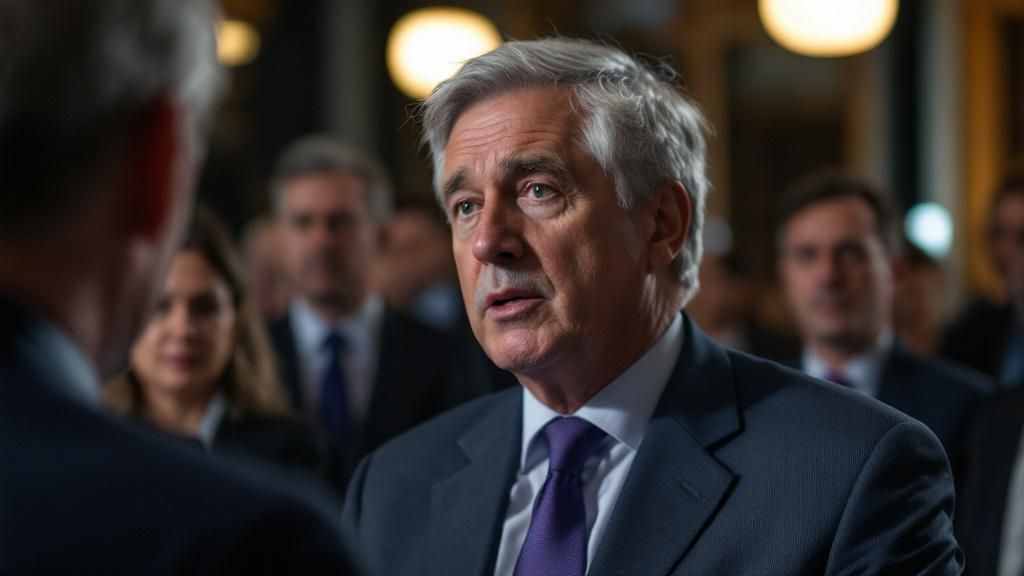
As households nationwide grapple with soaring energy bills and inflation reaching record levels, the opposition figurehead has launched a biting attack on the Prime Minister’s handling to the living costs crisis. In a fraught parliamentary exchange, the opposition has challenged the government’s insufficient relief measures, demanding greater intervention to help struggling families. This article explores the escalating divisions centred on the crisis and considers the rival visions for economic assistance.
The Opposition’s Critique of Government Policies
The leader of the opposition has intensified scrutiny of the government’s response to the worsening affordability crisis, arguing that existing policies prove inadequate in addressing the extent of difficulty impacting British families. During parliamentary exchanges, the opposition has presented a detailed critique encompassing inadequate financial support, limited involvement in the energy sector, and a apparent absence of speed in addressing inflation. The opposition argues that whilst families contend with extraordinary costs, the government’s piecemeal approach simply treats symptoms rather than tackling underlying causes of financial hardship.
Central to the opposition’s argument is the contention that the government has seriously underestimated both the scale and length of the crisis. Opposition representatives have highlighted figures suggesting that millions of people now face genuine hardship, with many obliged to select between keeping warm and feeding themselves. The opposition argues that the government’s early action did not fully gauge the crisis’s effect, resulting in relief measures that turned out to be insufficient when conditions worsened further. This error of judgment, they argue, reflects broader failures in economic prediction and policy planning.
Inadequate Assistance Provisions
The opposition has consistently challenged state assistance programmes as inadequate and misdirected, contending that price regulation frameworks do not adequately safeguard vulnerable populations effectively. Critics point out that whilst the government has introduced different funding schemes, including grants and council tax rebates, these measures deliver limited reprieve without tackling systemic issues. The opposition maintains that income-assessed support remain too restrictive, shutting out millions of families in work who nonetheless face difficulties with mounting expenses. Furthermore, they argue the government’s approach lacks the determination necessary to confront such an unparalleled economic difficulty.
Opposition analysis proposes that present welfare systems disproportionately disadvantage middle-income households who sit outside qualifying criteria for targeted assistance. The party has put forward different approaches incorporating universal payments, broadened support schemes, and state involvement in fuel sectors to stabilise prices. They emphasise that short-term solutions, though beneficial, do not address fundamental systemic change. The opposition contends that in the absence of significant law changes and enhanced government funding, households will keep facing acute financial strain for years to come.
Extended Economic Strategic Concerns
Beyond pressing crisis intervention, the opposition has posed key questions regarding the state’s long-term economic direction and competitiveness. Opposition analysts argue that the present method prioritises near-term political appearances over durable economic planning, possibly undermining Britain’s future economic wellbeing. They contend that without deliberate investment in renewable energy infrastructure, productive capacity, and workforce development, the nation risks prolonged economic stagnation. The opposition underscores that addressing cost of living pressures requires comprehensive reforms tackling output efficiency, creative advancement, and economic sector development alongside urgent relief measures.
The opposition has outlined concerns that government policy lacks consistency across different sectors, with energy policy, industrial strategy, and fiscal measures operating in isolation rather than as unified parts. Critics argue this disjointed strategy hinders resolution of core inflationary challenges and fundamental economic problems. The opposition pushes for a integrated strategic framework covering energy transition, manufacturing revival, and skills development. They maintain that true economic recovery necessitates radical policy overhaul rather than incremental adjustments to existing frameworks.
Government’s Response and Counter-arguments
The government has robustly defended its economic policy, arguing that the affordability pressures are primarily driven by worldwide circumstances beyond direct Westminster oversight. Ministers have emphasised the extraordinary scale of the energy shortage, arising from geopolitical conflicts and global supply chain breakdowns. They contend that their tailored support schemes, including the price cap on energy and living cost payments, constitute a balanced and economically prudent approach. The Government Treasury maintains that overspending could exacerbate inflation to a greater degree, damaging sustained economic stability and ultimately harming the identical households the opposition claims to champion.
Government spokespersons have stressed the substantial financial assistance previously allocated, amounting to billions of pounds in immediate aid to those in need. They contend that their approaches balance immediate relief with disciplined budgeting, preventing the debt spiral that uncontrolled expenditure could provoke. Ministers also draw attention to their efforts in boosting energy security through renewable investments and supply diversification. The government contends that whilst the opposition delivers sympathetic rhetoric, their proposed solutions lack economic credibility and would become unaffordable without raising tax rates or additional debt.
Furthermore, government officials highlight their resolve to confronting underlying economic challenges through output gains and business investment incentives. They argue that enduring recuperation requires fundamental economic restructuring rather than immediate financial relief. The executive branch holds this method in the end produces increased wealth and protection for the entire population.
